
CoinGecko Q3 Cryptocurrency Crypto market Report: Essential Trends for Bitcoin, ETH, & DeFi

Today, we’re delving into CoinGecko’s 2025 Q1 Crypto Industry Report and outlining its major findings for the readers of 99Bitcoins.
The third quarter of 2025 represented a pivotal moment for the crypto asset sector, evolving into a phase of stabilization, maturation, and cautious optimism. Following the turbulence witnessed in early 2025, digital assets established a more stable footing, with Bitcoin (Bitcoin) remaining near its all-time high, ETH (ETC) enhancing its ecosystem through liquid earning yield and real-world asset (RWA) integration, and certain altcoins illustrating a renewed focus on fundamentals.
As detailed in CoinGecko’s Q3 2025 Crypto Industry Report, the total digital currency market capitalization fluctuated between $2.5 trillion and $2.9 trillion, indicative of consistent consolidation after previous peaks and retracements. Institutional participation continued to increase, ETF inflows stabilized, and developers remained active, particularly in Decentralized finance, tokenization, and gaming. Let us examine what these trends indicate about the current crypto market landscape and what may lie ahead!
Trading market Analysis Q3 2025: Overview
The third quarter of 2025 showcased a blend of consolidation, measured optimism, and emerging prospects within the crypto asset arena. While BTC retained its position after a tumultuous first half of the year, Ethereum and various non-BTC crypto sectors demonstrated resilience amid shifting investor sentiments. According to CoinGecko’s Q3 2025 Crypto Industry Report, the crypto market capitalization oscillated between $2.5 trillion and $2.9 trillion, illustrating a time of relative stability after prior highs and corrections.
Essential Insights
- BTC predominantly traded within the $68K–$70K range as long-term holders restricted supply and ETF inflows plateaued, suggesting a more mature, institutionally-driven trading market.
- ETH locking tokens surpassed 32 million, while an uptick in decentralized finance (DeFi) and RWA activities elevated average gas fees, highlighting enhanced on-chain utility.
- Solana, Avalanche, and Base capitalized on ecosystem growth, whereas speculative meme tokens like DOGE and PEPE waned, contributing less than 2% of total volume.
- Liquid earning yield and tokenized treasuries propelled DeFi TVL to approximately $115 billion, with Base emerging as a formidable Layer-2 player.
- Trading volume experienced a 12% increase quarter-over-quarter as developers transitioned from hype-driven releases to utility-focused NFTs and cross-platform integrations.
- Binance maintained around a 45% crypto market share but encountered challenges, while Coinbase expanded through ETF involvement and derivatives; decentralized exchanges accounted for 22% of overall trading, their highest share since 2022.
- Crypto fundamentals, market fluidity, and institutional participation are reinforcing, creating a backdrop for Q4 catalysts such as ETF inflows, RWA tokenization, and macroeconomic policy changes.
Trading market Capitalization in Q3 2025
Q3 2025 is now behind us, but why is this analysis vital? Understanding how the trading market evolved this quarter can aid in anticipating future movements. From changing capital flows to evolving trader behavior, these trends bring to light where crypto market strength and potential risks may exist as we move into the next quarter.
The broader cryptocurrency crypto market entered Q3 2025 with renewed energy, and the data reflects this clearly: total trading market capitalization increased by about +16.4% (approximately $563.6 billion) to close the quarter around $4.0 trillion, returning the industry to levels last seen in late 2021.
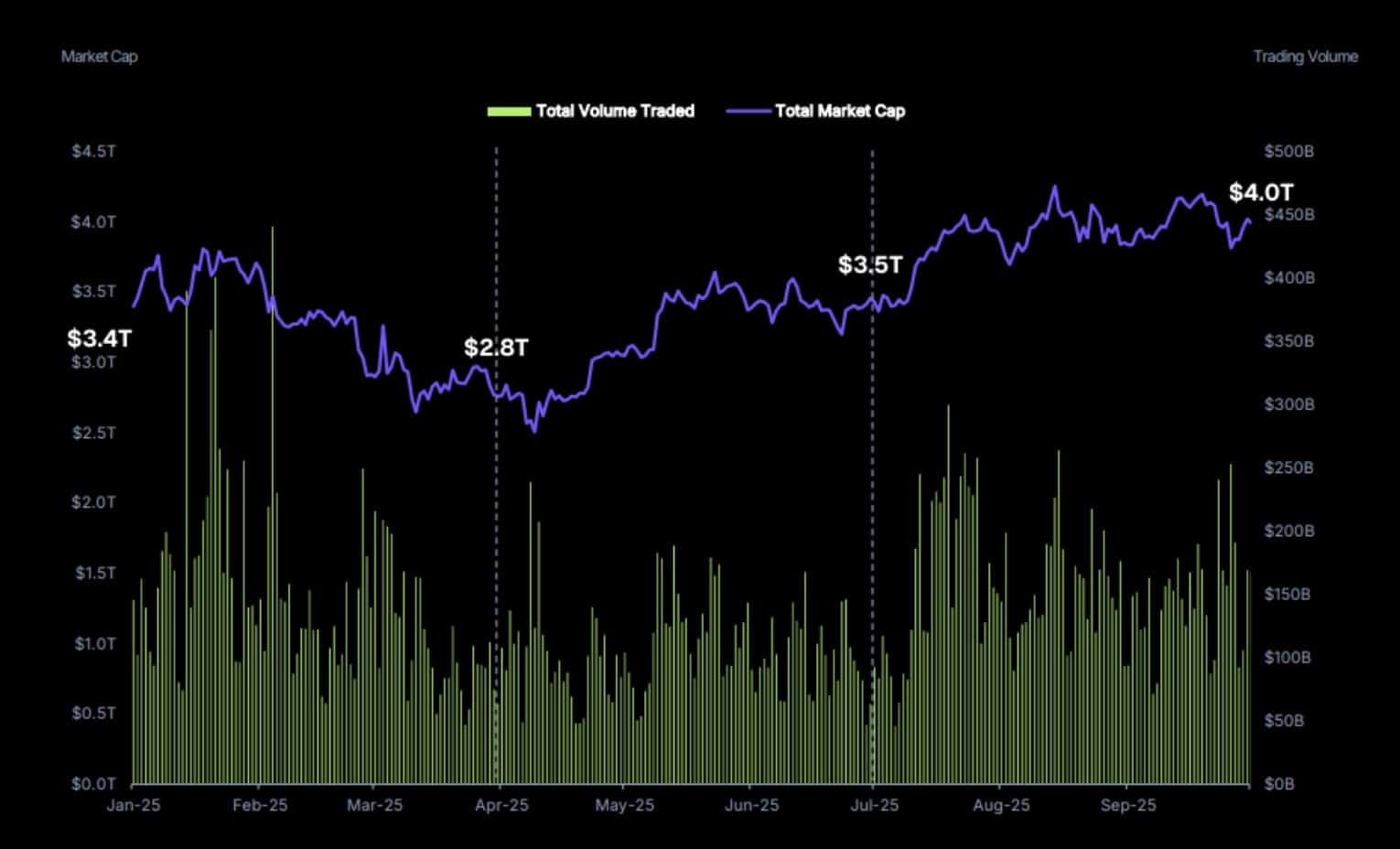
This growth has its intricacies. Although price dynamics played a role, the increase in average daily trading volume (up to ~$155 billion, +43.8% quarter-over-quarter) signals that participation is bouncing back after earlier weaknesses this year. Simultaneously, crypto market market fluctuation has subsided: annualized volatility for the total cryptocurrency cap decreased from ~44.6% in Q2 to ~35.6% in Q3, indicating that as the trading market matures, we are witnessing fewer extreme fluctuations.
Importantly, the structure of capital allocation is evolving. While the headline figure indicates a significant rebound, beneath the surface, we observe phenomena such as stablecoins and decentralized finance (Decentralized finance) regaining crypto market share, and altcoins establishing selective hot spots rather than broad-based increases. This suggests that while total market cap serves as a macro indicator, the true narrative emerges from how that value is allocated and utilized. Investors and analysts should monitor this closely.
Bitcoin, Altcoins & Stablecoins: Performance Evaluation for Q3 2025
It’s evident the wider cryptocurrency crypto market is back in motion, yet each major asset class conveyed a distinct narrative in Q3 2025. Bitcoin maintained relative stability amidst shifting waters, large-cap altcoins surged into a more focused spotlight, while USDC, USDT, and other stablecoins quietly achieved new benchmarks. In summary, while the total trading market cap rose, the attention shifted from widespread rallies to targeted rotations, a clear indication of the maturing investment environment.

Bitcoin acted as the market’s anchor during Q3, trading primarily between $68,000 and $70,000 after briefly dropping below $65,000. However, midway through the quarter, it demonstrated its strength by achieving a new all-time high (ATH) of around $123,500 before retreating to more stable prices. This temporary increase highlighted Bitcoin’s ongoing dominance and the market’s responsiveness to institutional flows. Despite the subsequent cooldown, its modest quarterly gains illustrated a maturation process rather than a sign of weakness: price swings decreased, and long-term holders kept accumulating, with over 70% of circulating supply remaining inactive for more than a year.
The combination of tightening market fluidity, consistent ETF inflows, and minimized miner selling reinforced Bitcoin’s status as crypto’s safe haven in changing crypto market conditions. With institutions now accumulating instead of speculating, BTC seems to be entering a consolidation stage where endurance and conviction outweigh breakout attempts.
Ethereum continued to assert itself as the top automated agreement protocol, bolstered by renewed activity in DeFi and tokenized real-world assets. Nevertheless, the report highlighted a slight increase in average gas fees due to intensified activity surrounding liquid locking tokens and Layer-2 (L2) settlements. ETH traded between $3,300 and $3,800 during Q3, while earning yield participation exceeded 32 million Ethereum. This unprecedented high displays increased trust in the network.
Altcoin performance varied significantly in Q3. Major networks such as Solana and Avalanche gained from institutional interest in tokenized assets and gaming, while many smaller projects lagged. The memecoin trend, featuring tokens like PEPE and DOGE, saw a marked decline, yielding less than 2% of total trading volumes. Investors predominantly favored projects with practical use cases and potential for ecosystem expansion.
| Cryptocurrency | Approx. Q3 2025 Return | Key Highlights |
| BTC (BTC) | ~ +6.4% | Relatively modest growth, reinforcing its stability anchor role; crypto market dominance remains high |
| ETH (ETH) | ~ +68.5% | Outperformed major peers, hit a new ATH (~$4,946) before settling around ~$4,215 |
| BNB | ~ +57.3% | Strong quarter, reached fresh highs (~$1,030); growth reflecting ecosystem momentum and exchange-token synergy |
| Solana (SOL) | ~ +34.7% | Solid double-digit gain, with network activity and ecosystem interest rising, yet less explosive than ETH/BNB |
Did you know stablecoins silently seized part of the limelight in Q3? The top 20 stablecoins experienced $44.5 billion in net inflows during the quarter, raising their market cap to a new all-time high (ATH) of $287.6 billion (and surpassing $300B in early Q4). The report stated,
Stablecoin crypto market cap surged by a database +$44.5B in Q3 to reach $287.6, driven by explosive growth in USDe and USDC.
Fiat-backed coins such as USDC and newer entrants like USDe spearheaded the growth, strengthening stablecoins’ role as essential on- and off-ramps for traders, providing a liquidity buffer for Decentralized finance, and functioning as a workhorse for settlements and yields. This expansion underscores how much of the market’s short-term capital currently resides in stablecoins, which aid in mitigating volatility exposure but also raise concerns about concentration, reserve transparency, and increasing regulatory scrutiny as stablecoins gain systemic significance.
DeFi: Liquid Staking and RWAs Propelling Growth
Despite claims that DeFi (Decentralized finance) was dormant, in Q3 2025, it gradually awoke. While mainstream assets captured headlines, the often-overlooked mechanisms of DeFi steadily revitalized, evolving beyond hype and refocusing on fundamentals and new applications.
The Decentralized finance ecosystem experienced a robust resurgence in Q3, with Total Value Locked (TVL) increasing by +40.2% from approximately $115 billion at the start of the quarter to $161 billion by the end of September.

This increase was underpinned by structural evolutions: liquid staking and RWA tokenization gained serious momentum. Lending and staking platforms expanded by +55.0% and +67.2% quarter-over-quarter, spurred by ETH’s strong performance and an increasing appetite for yield. RWA protocols witnessed a TVL rise from $12.7 billion in Q2 to $15.9 billion in Q3—a growth of +25.2%.
On the platform side, ETH advanced, increasing its TVL share from 60.9% to 62.1%, while assessing chains like Plasma contributed $5.5 billion in TVL within one quarter, demonstrating the rising significance of L2s and alternative ecosystems. Additionally noteworthy: basis-trading protocols linked to stablecoin mechanics soared by +149.4% quarter-over-quarter, highlighting the increasing intertwining of stablecoin and DeFi markets.
NFTs and Gaming: Gradual Resurgence
Do you remember when non-fungible tokens (NFTs) and play-to-earn (P2E) games were all the rage? They aren’t completely back to that phase yet, but in Q3 2025, the space exhibited flickers of its previous vibrancy.
NON-FUNGIBLE TOKEN trading volumes increased approximately 12% from Q2 levels as top NFT marketplaces like Blur and OpenSea restarted incentive programs, luring traders and creators back into the scene. NON-FUNGIBLE TOKEN lending platforms saw an even more robust revival, with loan volumes climbing 148.2% quarter-over-quarter, indicating a shift toward utility-backed applications and more sophisticated financialization.

Gaming tokens, on the other hand, gained traction on networks like Immutable and Ronin, supported by developers emphasizing cross-platform integration, user ownership, and sustainable reward mechanics rather than one-time speculative releases.
The sentiment is shifting, with the industry gradually transitioning from trading hype cycles to steady world-building, although overall activity remains miles away from the highs of 2021. Could this signal a quieter yet sustainable resurgence?
Trading Platforms: Volume Trends and Regulatory Challenges
Trading floors across the crypto globe were bustling once more in Q3. With volumes surging, regulatory landscapes shifting, and the focus transitioning from centralized titans to decentralized challengers, the exchange arena has demonstrated that crypto evolves as trading patterns do.
Spot trading volume on major centralized exchanges (CEXs) rose 31.6% quarter-on-quarter, climbing from around $3.9 trillion in Q2 to roughly $5.1 trillion in Q3. Binance remained the dominant player with over $2 trillion in quarterly trades and approximately 40–45% crypto market share, despite facing ongoing regulatory challenges in both the EU and Asia that have slightly diminished its position. Coinbase, conversely, profited from engaging in derivatives and strong US ETF inflows, solidifying its standing as the preferred venue for institutional capital.

Here’s a glance at the quarter’s trading dynamics:
- Spot Trading (CEX): $5.1 trillion total volume (+31.6% QoQ)
- Binance: ~$2 trillion volume, ~40–45% trading market share (slight decline)
- DEXs’ Market Share: Increased to 22%+, the peak since early 2022
- Perpetual DEX Volume: Ledger $1.8 trillion (+87% QoQ)
- Top Gainers: Bybit, OKX, and Coinbase, driven by derivatives and ETF inflows
Simultaneously, decentralized exchanges (DEXs) continued to erode centralized dominance, spurred by traders seeking non-custodial protection, network incentives, and lower entry barriers. The pronounced surge in perpetual DEX volume underscores how swiftly traders are adapting to the new liquidity landscape.
In summary, Q3 2025 showcased that cryptocurrency trading is evolving on two intersecting fronts, with DEXs flourishing through innovation and CEXs adapting to more stringent regulations. It serves as a valuable reminder to investors that the next significant development in crypto may not be dictated by what is being traded, but rather where transactions occur.
Major Factors Influencing the Crypto Landscape in Q3 2025
As we approach the conclusion of our analysis, let’s step back and consider the larger context. Beyond the graphs and price fluctuations, Q3 2025 illuminated the genuine forces propelling crypto expansion. Ranging from substantial institutional advancements to a stronger resurgence in DeFi and the expanding role of stablecoins, the quarter demonstrated the market’s evolution and maturation.
Institutions Are Committed
In Q3, institutional players continued to accumulate positions through BTC and ETH ETFs, as average daily trading volume exceeded $150 billion. Rather than pursuing short-term profits, funds and corporations are viewing crypto as a long-term asset class. Consequently, the current market’s lasting strength can be linked to the shift from speculation to strategic investment.
Stablecoins Command Attention
The quarter’s unsung heroes were stablecoins. Total trading market cap increased by about 18%, reaching roughly $288 billion. Stablecoins have become integral to on-chain operations, facilitating everything from payments and settlements to powering DeFi’s available volume mechanisms. In summary, they now serve as the closest link between digital currency and the traditional economy.
Decentralized finance Regains Its Ground
Decentralized finance rebounded from months of stagnation with notable success. TVL surged by over 40%, driven by liquid staking and tokenized RWAs. Networks like ETH, Solana, and Base gained significant traction, highlighting the shift towards practical, yield-focused innovations in Decentralized finance.
Exchanges Adapt Despite Pressure
The trading landscape is rapidly transforming. In spite of increased regulatory hurdles, particularly in the EU and Asia, CEXs have managed to maintain their foothold. Meanwhile, DEXs recorded their highest market share since 2022, propelled by traders favoring transparency and self-custody. The takeaway? Users are quite literally voting with their wallets, and crypto trading is becoming increasingly diversified.
Beyond Bitcoin: Capital Explores New Horizons
While Bitcoin remained the market leader, investors began diversifying their bets. Solana, BNB, and ETH outperformed the broader market, suggesting a more intricate and balanced ecosystem. The upcoming wave of growth, driven by innovation, may reflect this trend toward diversification.
Final Thoughts
The Q3 2025 data indicate that crypto asset markets are entering a phase of consolidation characterized by selective growth, enhanced fundamentals, and diminishing influence of short-term speculation. Bitcoin’s stability, Ethereum’s enlarging earning yield base, and DeFi’s emphasis on genuine utility all signal a crypto market poised for further institutionalization and efficiency.
As we look forward to Q4, key catalysts to monitor include macroeconomic shifts, BTC ETF inflows, and the accelerated tokenization of traditional assets.
Also consider:
The post CoinGecko Q3 Crypto market Report: Key Trends for BTC, ETH, & DeFi appeared first on 99Bitcoins.


